(And Why You’ve Made One Without Even Knowing It)
Let’s play a quick game:
Have you ever made a grocery list?
Tracked your baby’s nap schedule?
Kept a log of screen time, meals, chores, or (let’s be real) your toddler’s tantrums?
🎉 Ding ding! You’ve made a dataset.
Yep. Even if you’ve never touched Excel or used the word “data” in a sentence, you’re already doing it.
A dataset is just a collection of related information, usually in rows and columns, like a really polite way to keep your chaos organized. Believe it or not, you’re already a pro.
So… What is a dataset?
Imagine a spreadsheet where every row is a thing, and every column is a detail about that thing. That’s it. That’s the whole concept.
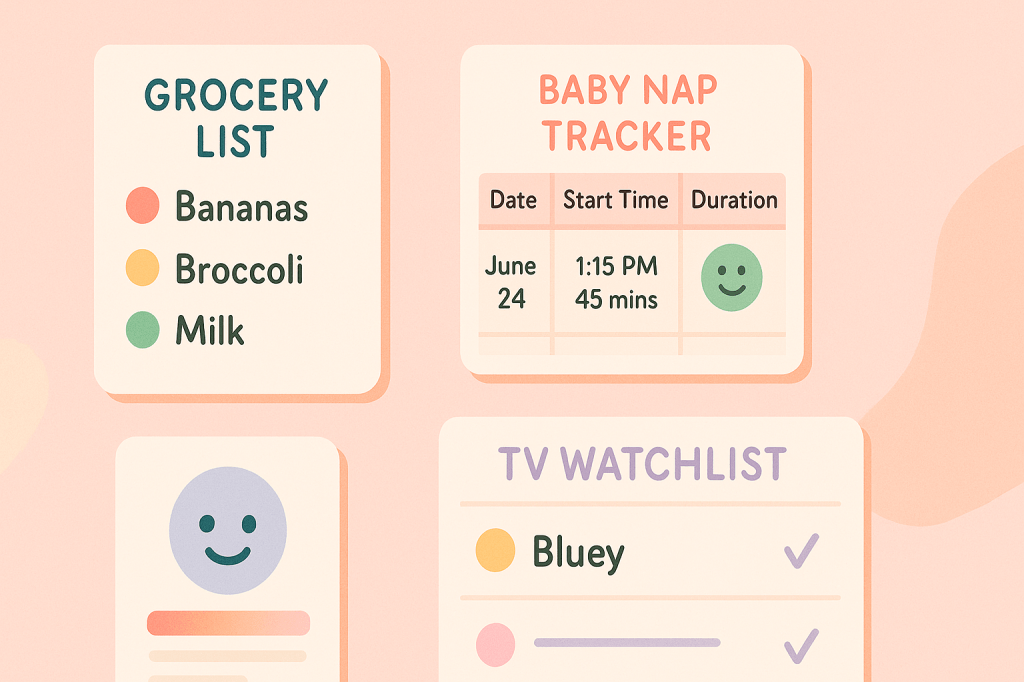
Here’s what that could look like IRL:
Grocery List Item: Bananas
- Item: Bananas
- Category: Fruit
- Quantity: 6
Nap Tracker
- Date: June 24
- Start Time: 1:15 PM
- Duration: 45 mins
- Mood After: Gremlin → Angelic
TV Watchlist
- Show: “Bluey”
- Watched?: Obviously
- Cried?: Maybe don’t ask
It’s not a techy thing. It’s a life thing.
Datasets are just how we make sense of all the tiny moving pieces.
Everyday Datasets You Didn’t Know Were Datasets
Let’s call these “accidental spreadsheets”:
- Your chore chart (rows = days, columns = what got done or… didn’t)
- Your baby feeding log (you know the one—you never thought you’d care this much about ounces)
- That shared grocery list where someone always forgets almond milk
- Your toddler’s tantrum log (peak meltdown data, anyone?)
Basically, if you’re tracking it, logging it, or color-coding it, you’re building a dataset, my friend.
Why Bother?
Because tiny patterns tell big stories.
Looking at your info side-by-side helps you notice things:
- “Oh, my toddler skips naps on days we go to Target.”
- “Turns out I doom-scroll Instagram most around 3:14 PM.”
- “I’ve had tacos for dinner three times this week. Not mad about it.”
You don’t need fancy tools or a data degree to spot trends.
You just need your own notes and a little curiosity.
Try This Today 👇
Make your own mini dataset. No pressure, just play.
Track something ordinary today:
- How many times you check your phone
- What snacks you reach for (and which ones actually keep you full)
- How long bedtime actually takes vs. how long it feels like it takes
Jot down the details. Then ask:
- What surprised me?
- What do I want to change?
- What can I learn?
🎉 Ta-da. You’re officially “doing data.”
Final Thought
You don’t need spreadsheets to be data-savvy. You just need to notice what’s already there. You’re collecting mini datasets every day just by living your life.
We’re not here to make data feel heavy—we’re here to make it human. 💛
Stay curious,
Sydney
 Data For Humans
Leave a comment