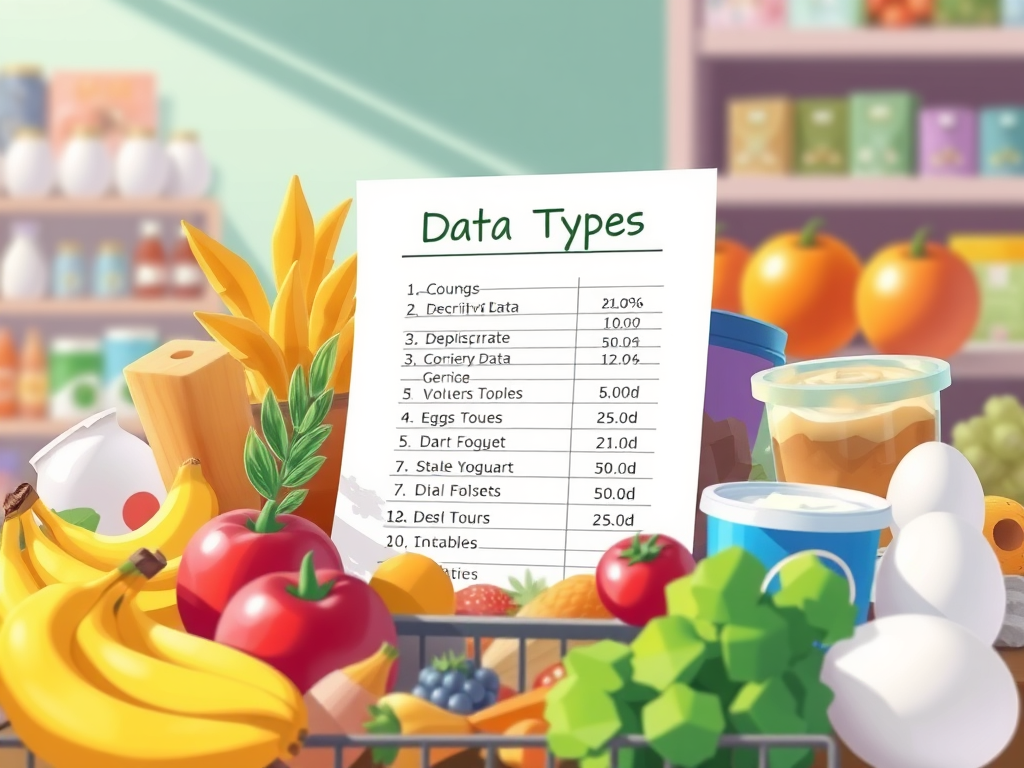
Have you ever written a grocery list, checked the weather app, or answered a quick survey at work? Congratulations — you’ve already interacted with different types of data! But let’s slow down and really get to know what that means.
Understanding data doesn’t start with spreadsheets or coding. It starts with knowing the types of data that help us describe, sort, and make sense of the world. So, let’s meet them: words, numbers, and a few things in between.
👣 My First Realization: I Was Using Data All Along
When I started my journey into the world of data, I didn’t come from a technical background. One day, I was sorting through old photos on my phone and noticed that I always organize them by season or by event — “Beach Day,” “Christmas 2022,” “Birthday Weekend.” That’s qualitative data. Then I checked how many photos I’d taken that month: 612 (yes, really). That’s quantitative data.
At that moment, it clicked: I’d been working with data every day without even realizing it.
📊 Two Big Categories: Qualitative vs. Quantitative
There are two main types of data: qualitative and quantitative. Here’s what they mean in plain language:
| Type of Data | What It Is | Real-Life Example |
|---|---|---|
| Qualitative | Descriptive words or categories | Your favorite movie genre: “Comedy” |
| Quantitative | Numbers you can count or measure | Number of steps you walked today: 6,500 |
Think of qualitative data as the “what kind” and quantitative data as the “how much” or “how many.”
🛒 Let’s Look at a Grocery List
Take a look at this imaginary shopping list:
- Bananas
- Yogurt
- Eggs (1 dozen)
- Pasta
- Milk (2 gallons)
Now let’s break that down:
- “Bananas,” “Yogurt,” “Pasta” = Qualitative (they’re names of items)
- “1 dozen eggs,” “2 gallons of milk” = Quantitative (they’re measurable amounts)
See how both types of data show up together, just in one list?
🧠 Quick Exercise: Sort the Data in Your Life
Let’s put your new skills to work.
Take a moment to think about your day today. Can you come up with:
- One thing you described using words?
(e.g., “It was cloudy outside” = qualitative) - One thing you measured with a number?
(e.g., “I drank 3 cups of coffee” = quantitative)
Write them down. That’s it! You’re officially working with data.
✨ Quick Reference: Data Type Cheat Sheet
| Term | What It Means | Example |
|---|---|---|
| Qualitative Data | Descriptions, labels, categories | “Blue,” “Happy,” “Yes” |
| Quantitative Data | Measurable numbers or amounts | “4 miles,” “82°F,” “$15.99” |
| Categorical | Group-based (a type of qualitative) | “Dog,” “Cat,” “Fish” |
| Continuous | Measured and can take any value | “5.2 feet,” “19.99 hours” |
| Discrete | Countable numbers (often whole) | “3 siblings,” “10 cookies” |
🗣️ Final Thoughts
Understanding data doesn’t mean learning a new language — it just means noticing how you already describe and measure your world. From now on, every time you jot down a to-do list, check the weather, or track your expenses, remember: that’s data, and you’re already a natural at using it.
Let’s keep this journey going, one bite-sized concept at a time.
 Data For Humans
Leave a comment